|
|
June 1953 Uprising

On June 16,
1953,
following a production quota increase of 10 percent for workers
building East Berlin's new boulevard the Stalinallee, (today's
Karl-Marx-Allee), demonstrations by disgruntled workers broke out in
East Berlin.
The next day the protests spread across East Germany with more than a
million on strike and demonstrations in 700 communities. Fearing
revolution the government requested the aid of Soviet occupation troops
and on the morning of the 18th tanks and soldiers were dispatched who
dealt harshly with protesters. The result was some fifty deaths and a
wave of arrests and jail sentences numbering over 10,000. Transit
between West and East Berlin was relatively free at the time,
meaning that the protests and the harsh Soviet reaction unfolded in
full view of many western observers.

Stasi
officers
The Stasi
The East Germans soon formed a Ministry for
State Security ( Staatssicherheit- Stasi )with agents and informers
.During
the early stages of the occupation, the Soviet army seized a great deal
of industrial equipment from eastern Germany to be shipped back to the
Soviet Union as war reparations, crippling the East German economy for
years. The increasing economic prosperity of West Germany led large
numbers of East Germans to flee to the West.
Since the 1940s, East Germans had been leaving the Soviet zone of
Germany to emigrate to the west. The ongoing emigration of East Germans
further strained the East German economy.
The
Berlin Wall

East German border guard escaping to the West
Although the
German border
between the two Germanies was largely closed by the mid-1950s ,
the sector borders in Berlin were relatively easy to cross. Due to the
lure of higher salaries in the West and political oppression in the
East, many skilled workers (such as doctors) crossed into the West,
causing a 'brain drain' in the East. However, on the night of August
13, 1961, East German troops sealed the border between West and East
Berlin and started to build the Berlin Wall,
literally and physically enclosing West Berlin. Travel was greatly
restricted into, and out of, East Germany. A highly effective security
force called the Stasi monitored
the lives of East German citizens to suppress dissenters through its
network of informants and agents. At least 133 people were confirmed killed
trying to cross the Wall into West Berlin .
Erich
Honecker and the Fall of East Germany

Erich
Honecker
In 1971,
Erich Honecker replaced Walter Ulbricht as head of state. East Germany
was generally regarded as the most economically advanced member of the
Warsaw Pact. Before the 1970s, the official position of West Germany
was that of the Hallstein Doctrine which involved non-recognition of
East Germany. In the early 1970s, Ostpolitik led by Willy Brandt led to
a form of mutual recognition between East and West Germany. The Treaty
of Moscow (August 1970), the Treaty of Warsaw (December 1970), the Four
Power Agreement on Berlin (September 1971), the Transit Agreement (May
1972), and the Basic Treaty (December 1972) helped to normalise
relations between East and West Germany and led to both Germanies
joining the United Nations.

an
East German girl entering West Germany in 1989
In
September 1989 Hungary
removed its border restrictions and unsealed its border and more than
13,000 people left East Germany by crossing the "green" border via
Czechoslovakia into Hungary and then on to Austria and West Germany.
Many others demonstrated against the ruling party, especially in the
city of Leipzig. Kurt Masur, the conductor of the Leipzig Gewandhaus
Orchestra led local negotiations with the government, and held town
meetings in the concert hall. The demonstrations eventually led Erich
Honecker to resign and in October he was replaced by Egon Krenz.

fall
of the Berlin Wall
On
November 9, 1989
a few sections of the Berlin Wall were opened, resulting in thousands
of East Germans crossing into West Berlin and West Germany for the
first time. Soon, the governing party of East Germany resigned.
Although there were some small attempts to create a permanent,
democratic East Germany, these were soon overwhelmed by calls for
unification with West Germany. After some negotiations (2+4 Talks,
involving the two Germanies and the former Allied Powers United States,
France, United Kingdom, and the Soviet Union), conditions for German
unification were agreed upon. The East German territory was reorganized
into five states. Thus, on October 3, 1990 the five East German states
plus East Berlin joined the Federal Republic of Germany.
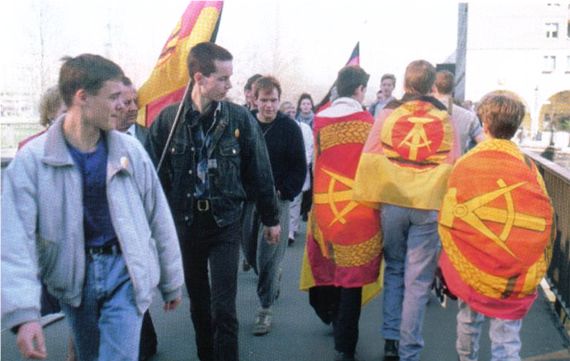
East German teens against
reunification in the election of 1990
|
|