German Reunification
Foreign Reservations about German Reunification
High cost of Reunification
|
|
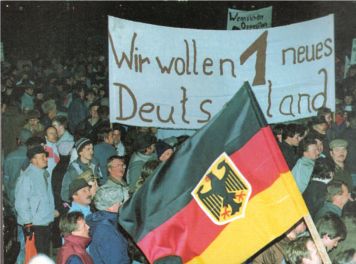
Protesting for reunification in Leipzig
Faced by continued large demonstrations, Egon Krenz was forced to resign. The Volkshammer meet with its first true open election, removing Honecker and Mielke from power, effectively ending the old SED.On Nov 17, 1989, a new cabinet was elected.
Live American broadcasts on October 3, 1990 as Germany officially celebrates Reunification.
Although there were some small attempts to create a permanent, democratic East Germany, these were soon overwhelmed by calls for unification with West Germany. After Nov, the chant 'Wir sind das Volk' became 'Wir sind ein Volk' (We are one people) .
On October 3, 1990, the five East German states officially joined the Federal Republic of Germany, while East and West Berlin united as a third city-state .Over 93% of East German voters went to the polls. It was decided that the capital would return to Berlin starting in 1998.
Foreign Reservations about German Reunification
Many foreign countries had reservations about German unification . Margaret Thatcher feared it might undermine the stability of Eastern Europe and cause hard line Communists to regain power in the Soviet Union. The French had old fears of Germany going back to the Franco-Prussian War of 1871.The old saying was ' Germany doubled equals France halved .' The Poles wanted the lands on the Oder and Neisse rivers , given to them after WW II, to remain with them. Russian still had vivid memories of the German invasions of WW I and II and also wanted to keep NATO out of the former East Germany. Of the wartime Allies, only the Americans supported reunification completely.
By 1990 the East German treasury was nearly bankrupt and the economy in serious disarray. The Allies realized German would have to be reunited soon if they wished it or not. A Two Plus Four plan was drawn up in Feb 1990. Bush insisted that four power control of Germany would end when unification took place . The Germans would decide about NATO membership themselves . Gorbachev realized he could not push the NATO issue too far and lose a showdown with the West . It was agreed on July 14 between Kohl and Gorbachev that Germany would make no claim over territory lost after WWI and would not develop nuclear, chemical or biological weapons. NATO would not station nuclear weapons in former East German territory. The Soviets would have several years to remove their troops from Germany, Germany could remain a member of NATO. The issue of abortion, which was legal in East Germany but limited in West Germany. This issue was sidestepped for 2 years .
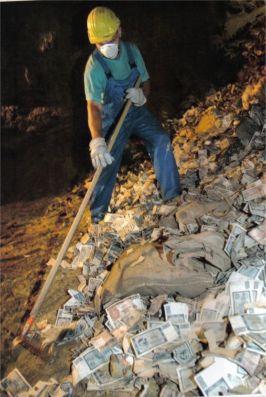
Worthless East German Marks being burned after reunification
Reunification came with a hefty price tag - about 2 trillion euros. More than half that went into social services and programs. About 300 billion euros went into renewing infrastructure and transportation. The massive transfer of funds from west to east spurred an economic boom in western Germany as well as in the former east.
The economy of East Germany, one of the strongest Eastern Europe was also in poor shape after years of centralized planning .Industries in the GDR were grouped together in conglomerates known as Kombinate .A new state agency, the Treuhandanstadt or Trusteeship, was formed to manage privatization .By 1992 over 9,000 businesses had been privatized .The cost of reunification was massive. To modernize the telephone system alone cost $30 billion. Roads and schools were in terrible shape and there was much environmental pollution . Germany also had to pay about $7.6 billion to withdraw Russian troops from East Germany and provide them with housing in Russia .Some have estimated that Germany had spent nearly $1 trillion to reunite by the year 2000, damping the support of many West Germans for reunification and making South Koreans worry about the cost of reunification with North Korea, which would be even more expensive .
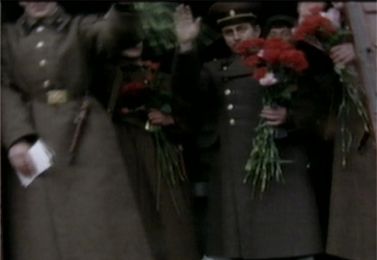
Soviet troops leaving East Germany
Last Russian Troops Leave Germany Boris Yeltsin arrived in Berlin on Tuesday (30/8) to take part in farewell ceremonies marking the end of almost 50 years of Russian and Soviet troop presence on German soil. To this day, there remain vast differences between the former East Germany and West Germany (for example, in lifestyle, wealth, political beliefs and other matters) and thus it is still common to speak of eastern and western Germany distinctly. The Eastern German economy has struggled since unification.
On October 3, 2015, Germany will celebrate 25 years of unity. Just like the infants born in 1989-90, the reunified country has come of age. At 25, you might have already achieved something in life. Or you might have already failed. Or you might have just left for pastures new. But what exactly drives this generation of young Germans? What world do they move around in? How do they see the future? And what’s their take on the fall of the Berlin Wall and German reunification? "Generation 25” looks into the lives of today’s 25-year-olds. From YouTube star to mayor, from Wine Queen to aspiring monk: a snapshot of the zeitgeist and lifestyles that are as diverse as this generation itself.
|
|
||
|
|
|
|||